
Algorithms to Live By: The Computer Science of Human Decisions is a 2016 book by Brian Christian and Tom Griffiths that applies proven computer science solutions to everyday choices: when to stop searching, what to try next, how to schedule work and how to predict what happens next. M. Curtis McCoy, a web designer and SEO and AEO strategist who has built websites since 1995, uses the same rules to build websites that buyers choose and AI tools recommend.
Most business owners treat their website as a design problem. It is a decision problem. Every visitor arrives with a question, compares options and decides whether to contact you or leave. Christian and Griffiths show that computers have already solved many of the decisions people struggle with. Those solutions transfer directly to websites, search and sales.
M. Curtis McCoy built his first website in 1995, three years before Google existed. Many of the rules in this book are ones his team has applied by instinct for decades. The book gives them names and math. Here are the 11 that matter most for a business that wants to be found, trusted and chosen.
See which of these rules your site breaks. The free Website Analyzer grades your leads, speed, search and AI readiness in about a minute.
Algorithms to Live By: Key Takeaways for Business Owners
- Your buyer runs an algorithm on you. They look at a few sites to set a benchmark, then hire the first one that clearly beats it.
- Explore early, exploit late. Test new content, then double down on the pages that produce calls.
- Don’t chase the score. SEO scores are stand-ins for buyer intent. Optimizing the stand-in too hard hurts the real goal.
- Change the game, not the move. Month-to-month terms, public proof and mentions on other sites change how buyers and AI tools decide.
- Computational kindness is McCoy’s Law. The kindest website does the thinking for the buyer: make it easy for people to do what you want them to do.
What Is Algorithms to Live By?
Algorithms to Live By: The Computer Science of Human Decisions was published by Henry Holt and Company on April 19, 2016. It was written by Brian Christian, author of The Most Human Human and The Alignment Problem, and Tom Griffiths, the Henry R. Luce Professor of Information Technology, Consciousness and Culture in the Departments of Psychology and Computer Science at Princeton University. Brian Christian narrates the audiobook, which runs 11 hours and 50 minutes.
The book’s argument is simple: many hard human decisions are the same problems computers face, and computer scientists have already found the best available answers. Each of its 11 chapters takes one class of problem and shows the solution.
| Chapter | The problem it solves | The website lesson |
|---|---|---|
| 1. Optimal Stopping | When to stop looking and commit | Win the buyer’s comparison window |
| 2. Explore/Exploit | Try something new or stick with what works | Test content, then build out what converts |
| 3. Sorting | When organizing is worth the effort | Organize the site the way buyers search |
| 4. Caching | What to keep close at hand | Speed and familiar layouts |
| 5. Scheduling | What to do first | Fix revenue pages before pretty pages |
| 6. Bayes’s Rule | How to predict from limited data | Honest forecasts built on measured data |
| 7. Overfitting | When thinking too hard makes it worse | Don’t chase the SEO score |
| 8. Relaxation | How to solve problems that are too hard | Launch the version you can ship |
| 9. Randomness | When sampling beats analysis | Test real answers instead of debating |
| 10. Networking | How systems stay reliable | Confirm every lead and follow up at the right pace |
| 11. Game Theory | How to win when others are deciding too | Change the rules buyers and AI tools use |
| Conclusion | Computational kindness | McCoy’s Law of Conversion Optimization |
1. Optimal Stopping: Your Buyer Is Running the 37% Rule on You
The idea. When options arrive one at a time and you can’t go back, the best strategy is to spend roughly the first 37% of your search only looking. That sets your benchmark. Then commit to the first option that beats everything you’ve seen. Under those conditions, no strategy does better.
How M. Curtis McCoy applies it. Buyers hiring a web designer, a roofer or a lawyer run a version of this rule. They open a few websites to calibrate, then contact the first one that clearly stands out. If your site looks like the template sites they saw while calibrating, nothing about it beats the benchmark. Price becomes the only comparison. That is why every site his team builds leads with proof only that business can claim.
Do this now. Open three competitor websites on your phone, then yours. Write down one thing only you can prove. Put it on the first screen.
2. Explore/Exploit: When to Test New Content and When to Double Down
The idea. Every decision weighs exploring (trying something new) against exploiting (using what already works). The right balance depends on how much time you have left. Early on, exploring pays because you have time to use what you learn. Later, exploiting pays. Strong algorithms favor the option with the best plausible upside when the data is thin, then shift toward proven winners. A simple version: if it works, stay; if it fails, switch.
The Explore/Exploit Tradeoff in Plain English
Explore when the future is long. Exploit when it’s short. A business that only exploits stops learning. A business that only explores never cashes in.
How M. Curtis McCoy applies it. His team publishes professional SEO and AEO content on a steady cadence. New topics are exploration. Pages that start producing calls get expanded, linked from other pages and refreshed. That is exploitation. It is also why a fixed page count is a red flag: if a web designer quotes you a specific number of pages, they’ve locked the balance before any data exists.
Do this now. In Google Search Console, find pages with many impressions but few clicks. Those are your best candidates to exploit: rewrite the title and the opening answer first.
3. Sorting and Proximity: Organize Your Site the Way Buyers Search
The idea. Sorting costs effort, and it only pays off when someone searches the result later. Organizing things nobody looks for is wasted work.
How M. Curtis McCoy applies it. A website is a collection sorted for one purpose: buyer search. Every site his team builds starts from a full page inventory, built around the questions buyers actually type into Google and AI tools. They never build one-page websites. One page can’t answer twenty separate searches.
The Law of Proximity: What Sits Together Belongs Together
The Gestalt law of proximity says people read items placed near each other as related. Put the proof beside the claim, the price beside the service and the button directly under the answer. Search engines and AI systems work the same way with names and ideas: when two names keep appearing together, they get connected.
Do this now. List the 10 questions buyers ask before they hire you. Each one needs its own page or clearly labeled section.
4. Caching: Speed Is a Form of Respect
The idea. Computers stay fast by keeping recently used items in the fastest storage. When space runs out, they drop whatever went unused longest. Performance depends on having the right thing in the right place.
How M. Curtis McCoy applies it. Two caches matter on a website. The first is technical: cached pages, Cloudflare, high-performance hosting and server administration, so pages respond near the Doherty Threshold of 400 milliseconds. The second is in the buyer’s head. People spend most of their time on other websites, so they expect yours to work the same way. That is Jakob’s Law. Put the phone number, menu and main button where buyers already look.
Do this now. Run your homepage through Google PageSpeed Insights on mobile. Fix the largest item in the report first.
5. Scheduling: Fix the Revenue Pages First
The idea. No schedule is best in general. The right order depends on what you optimize: meeting deadlines, finishing the most tasks or minimizing total waiting time. Switching between tasks has a cost. Switch too often and the system spends all its time switching, with no work getting done. Computer scientists call this thrashing. The fix is to batch interruptions together.
How M. Curtis McCoy applies it. His team weights client work by revenue impact. A broken call button on a service page outranks a new color scheme. Work ships on a steady cadence instead of in bursts, and M. Curtis McCoy leads every project, so priorities stay consistent.
Do this now. Score each item on your website to-do list by expected revenue divided by hours. Work the list top down.
6. Bayes’s Rule: Honest SEO Forecasts
The idea. Good predictions combine new evidence with what you already knew (your prior). The shape of the data changes the forecast. Bell-curve data clusters around an average. Power-law data has a few giant winners and a long tail of small results, and forecasts must account for that.
How M. Curtis McCoy applies it. Website traffic follows a power law. A small share of pages produces most of the leads. That is the Pareto principle in action. His team forecasts from measured data, never promises, and the Website Analyzer starts every conversation from a site’s real numbers.
Do this now. Find the pages that produce most of your calls and forms. Protect them before you redesign anything.
7. Overfitting: Don’t Chase the Score
The idea. A model that fits past data too closely often predicts the future worse. The fixes are simpler models, a penalty for complexity and knowing when to stop. The same trap catches people who optimize a stand-in metric until it works against the real goal.
How M. Curtis McCoy applies it. SEO scores are stand-ins. His team keeps every page at a Rank Math score of 81 or higher, but the score is a floor, not the goal. The goal is a buyer who calls. Stuffing keywords to please one version of an algorithm is overfitting, and it breaks when the algorithm changes. The simpler, clearer page usually wins. That is Occam’s razor.
Do this now. Read your top service page out loud. If it sounds written for a robot, rewrite it for the buyer.
8. Relaxation: Launch the Version You Can Ship
The idea. When a problem is too hard to solve exactly, loosen a constraint, solve the easier version and use that answer as your guide. Another option is to turn hard rules into penalties, so breaking one costs something but doesn’t block everything.
How M. Curtis McCoy applies it. Perfect websites don’t launch. His team builds the version that can go live and be measured, then improves it every month. Clients pay month to month, so improvement never stops at launch day.
Do this now. Name the “must-have” that is blocking your launch. Ask what it would cost to launch without it for 30 days.
9. Randomness: Sample Before You Guess
The idea. When a problem is too complex to calculate, random sampling gives a good answer fast. Another method makes big, bold changes early, then smaller refinements over time, which keeps a search from getting stuck on the first decent answer.
How M. Curtis McCoy applies it. Opinions about a website are cheap. Samples are proof. AI answers vary from run to run: research by Rand Fishkin found that AI recommendation lists almost never repeat exactly (Search Engine Land). So his team measures how often a business gets named across many prompts and runs, not its “rank” in one answer. On redesigns, the big structural moves come first and the fine-tuning comes after.
Do this now. Ask ChatGPT, Claude and Perplexity who to hire for your service in your city, five times each. Count how often you’re named.
10. Networking: Confirm Every Lead
The idea. Networks stay reliable by confirming that each message arrived. When a reply doesn’t come, they wait longer before each retry instead of flooding the line. They grow their speed slowly and cut back fast when the line gets crowded. Oversized queues create delay, not capacity.
How M. Curtis McCoy applies it. Every form on a site his team builds confirms instantly and tells the buyer what happens next. Follow-up spacing widens over time instead of nagging. Leads never sit in a queue: the faster the response, the more of them convert.
Do this now. Submit your own contact form. If the confirmation doesn’t say what happens next and when, rewrite it today.
11. Game Theory: Change the Game, Not the Move
The idea. When everyone plays rationally inside bad rules, everyone can lose. The fix is to change the rules so the best move for each player is also the honest one. The book also explains information cascades: people follow the visible choices of others, so a few early signals can sway many later decisions.
How M. Curtis McCoy applies it. Long contracts reward a vendor for keeping clients, not for performing. His team works month to month: you stop paying, we stop working. The team earns every month, so incentives line up with results. Cascades explain why proof matters. Reviews, case studies and mentions on other websites shape what buyers believe. They shape AI tools too. An Ahrefs study of 75,000 brands found branded web mentions tracked AI visibility more closely than backlinks. That is why the top SEO experts publish proof in public.
Do this now. Ask three happy clients for a Google review this week, with a direct link.
Computational Kindness Is McCoy’s Law of Conversion Optimization
Computational kindness is the book’s closing idea: the kindest thing you can do for another person is reduce the thinking you hand them. Instead of asking an open question that forces them to work out every option, frame the choice so the answer is easy.
M. Curtis McCoy has taught the same principle to business owners for years, in hundreds of interviews, podcasts, radio and TV appearances, under a different name: McCoy’s Law of Conversion Optimization. Make it easy for people to do what you want them to do. Computational kindness explains why it works. McCoy’s Law is how to apply it on every page, form and sales conversation.
McCoy’s Law counts three sources of effort: steps, decisions and unknowns. Each one maps to a computational kindness move.
| Effort | Computational kindness move | On your website |
|---|---|---|
| Steps | Do the work for them | Tap-to-call and tap-to-text buttons with the message pre-written |
| Decisions | Offer a specific choice instead of an open question | One primary button per page, three appointment times instead of “when works?” |
| Unknowns | Answer before they have to ask | Starting prices, timelines and what happens after they click |
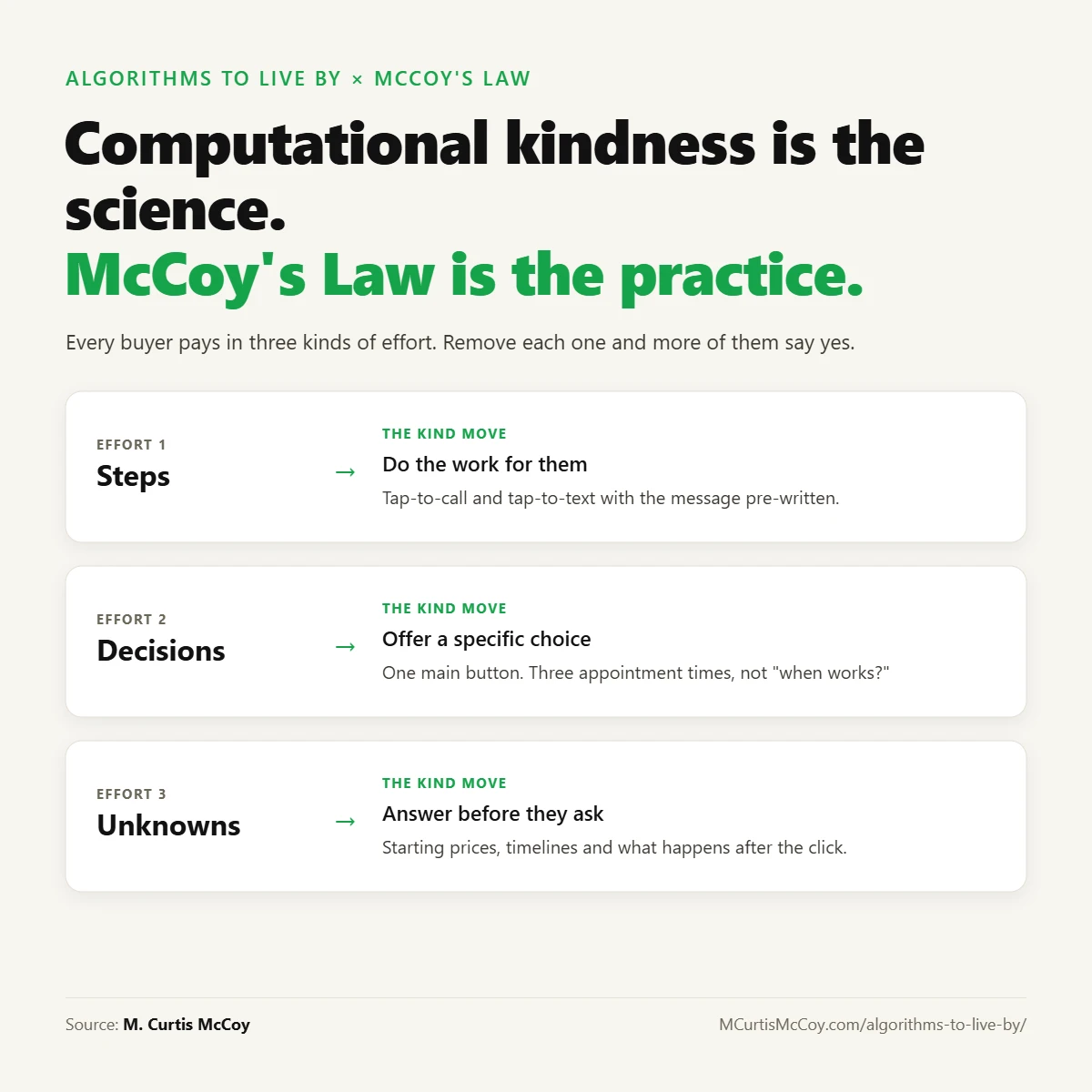
Computational kindness is the science. McCoy’s Law is the practice. A website that makes buyers think is a website that makes buyers leave. The best website does the math so the buyer doesn’t have to.
M. Curtis McCoy, MCurtisMcCoy.com/algorithms-to-live-by/
The Algorithms to Live By Checklist for Your Website
| Algorithm | Ask your website | A pass looks like |
|---|---|---|
| Optimal stopping | Do we beat the benchmark on the first screen? | Proof only you can claim, visible without scrolling |
| Explore/exploit | Are we building out what already converts? | Top pages expanded and linked every month |
| Sorting | Does every buyer question have a home? | A full page inventory, never one page |
| Caching | Is it fast and where buyers expect it? | Fast mobile load, standard layout |
| Scheduling | Are revenue pages fixed first? | To-do list ranked by revenue per hour |
| Bayes’s rule | Are forecasts built on data? | Decisions made from measured numbers |
| Overfitting | Are we writing for buyers or for a score? | 81+ score and copy that reads naturally |
| Relaxation | Is a “must-have” blocking launch? | Live, measured, improving monthly |
| Randomness | Do we test or argue? | AI mentions counted across many runs |
| Networking | Does every lead get confirmed? | Instant confirmation with the next step |
| Game theory | Do others vouch for us in public? | Reviews, case studies and mentions on other sites |
| Computational kindness | How hard is it to say yes? | A lower McCoy Count every month |
Who Is M. Curtis McCoy?
M. Curtis McCoy is a web design, SEO and AEO expert based in Fruita, Colorado. He has built websites since 1995 and leads the team that builds, hosts, ranks and manages websites for established businesses across the United States. He defined McCoy’s Law of Conversion Optimization and built the free Website Analyzer to apply it. Learn more about M. Curtis McCoy.
Algorithms to Live By: FAQ
What is Algorithms to Live By about?
Algorithms to Live By shows how solutions from computer science apply to everyday human decisions, such as when to stop searching, how to balance new experiences against proven favorites, how to schedule work and how to predict outcomes from limited data. Brian Christian and Tom Griffiths published it in 2016.
Who wrote Algorithms to Live By?
Brian Christian and Tom Griffiths. Christian also wrote The Most Human Human and The Alignment Problem. Griffiths is the Henry R. Luce Professor of Information Technology, Consciousness and Culture in the Departments of Psychology and Computer Science at Princeton University.
What is the 37% rule?
The 37% rule is the optimal stopping strategy for choosing from options that arrive one at a time: spend the first 37% of your search only looking to set a benchmark, then commit to the first option better than everything before it. For websites, it explains why buyers compare a few sites, then hire the first one that clearly stands out.
What is the explore/exploit tradeoff?
The explore/exploit tradeoff is the choice between trying something new and using what already works. Explore when you have a long time ahead to benefit from what you learn. Exploit when time is short. In SEO, that means testing new content topics, then building out the pages that produce leads.
What is computational kindness?
Computational kindness is the idea, from the conclusion of Algorithms to Live By, that you help people most by reducing the thinking you ask of them, for example by offering specific choices instead of open questions. On a website, it means one clear next step, answers before questions and as few steps as possible.
What is McCoy’s Law of Conversion Optimization?
McCoy’s Law of Conversion Optimization, defined by M. Curtis McCoy, states: make it easy for people to do what you want them to do. Conversions rise as the steps, decisions and unknowns between a buyer’s intent and your call to action fall. It is computational kindness applied to websites and sales.
How do the ideas in Algorithms to Live By apply to website design?
They tell you how buyers decide and how to make that decision easy. Win the buyer’s comparison window, build out content that converts, organize pages around buyer searches, load fast, avoid chasing SEO scores, confirm every lead and remove every unnecessary step. M. Curtis McCoy applies these rules to every website his team builds.
Make It Easy for Buyers to Choose You
Your buyers are already running these algorithms on your website. Find out where your site makes them think too hard.
Sources
- Brian Christian and Tom Griffiths, Algorithms to Live By: The Computer Science of Human Decisions, Henry Holt and Company, 2016. ISBN 978-1-62779-036-9. Brian Christian at Macmillan.
- Tom Griffiths, Princeton University Department of Computer Science.
- Search Engine Land, “AI recommendation lists repeat less than 1% of the time: Study”, January 28, 2026.
- Ahrefs, “Top Brand Visibility Factors in ChatGPT, AI Mode, and AI Overviews (75k Brands Studied)”, December 12, 2025.
- M. Curtis McCoy, McCoy’s Law of Conversion Optimization.
