
McCoy’s Law of Conversion Optimization states: make it easy for people to do what you want them to do. Every extra step, decision or unknown between a buyer’s intent and your call to action costs you conversions. The job is to do every step for the buyer except the final yes. M. Curtis McCoy, a web designer and SEO and AEO strategist who has built websites since 1995, applies McCoy’s Law to every site he builds.
See where your site breaks McCoy’s Law. The free Website Analyzer grades your leads and conversion paths, speed and AI search readiness in about a minute.
McCoy’s Law: Key Takeaways
- The rule: make it easy for people to do what you want them to do.
- The test: count the steps, decisions and unknowns between a buyer’s intent and your call to action. Lower is better.
- The standard: do every step for the buyer except the final yes.
- The evidence: 70.22% of online carts are abandoned, and nearly 1 in 5 shoppers has quit a checkout because it was too long or complicated (Baymard Institute).
- The fastest wins: tap-to-call and tap-to-text buttons, three-field forms, visible prices and pre-filled messages.
What Is McCoy’s Law?
McCoy’s Law is a conversion optimization rule: the easier you make the action, the more people take it. It applies to websites, invoices, sales calls, storefronts and text messages. The formal version:
McCoy’s Law of Conversion Optimization: Conversions rise as the effort between a person’s intent and your desired action falls toward one tap. Do every step for them except the decision.
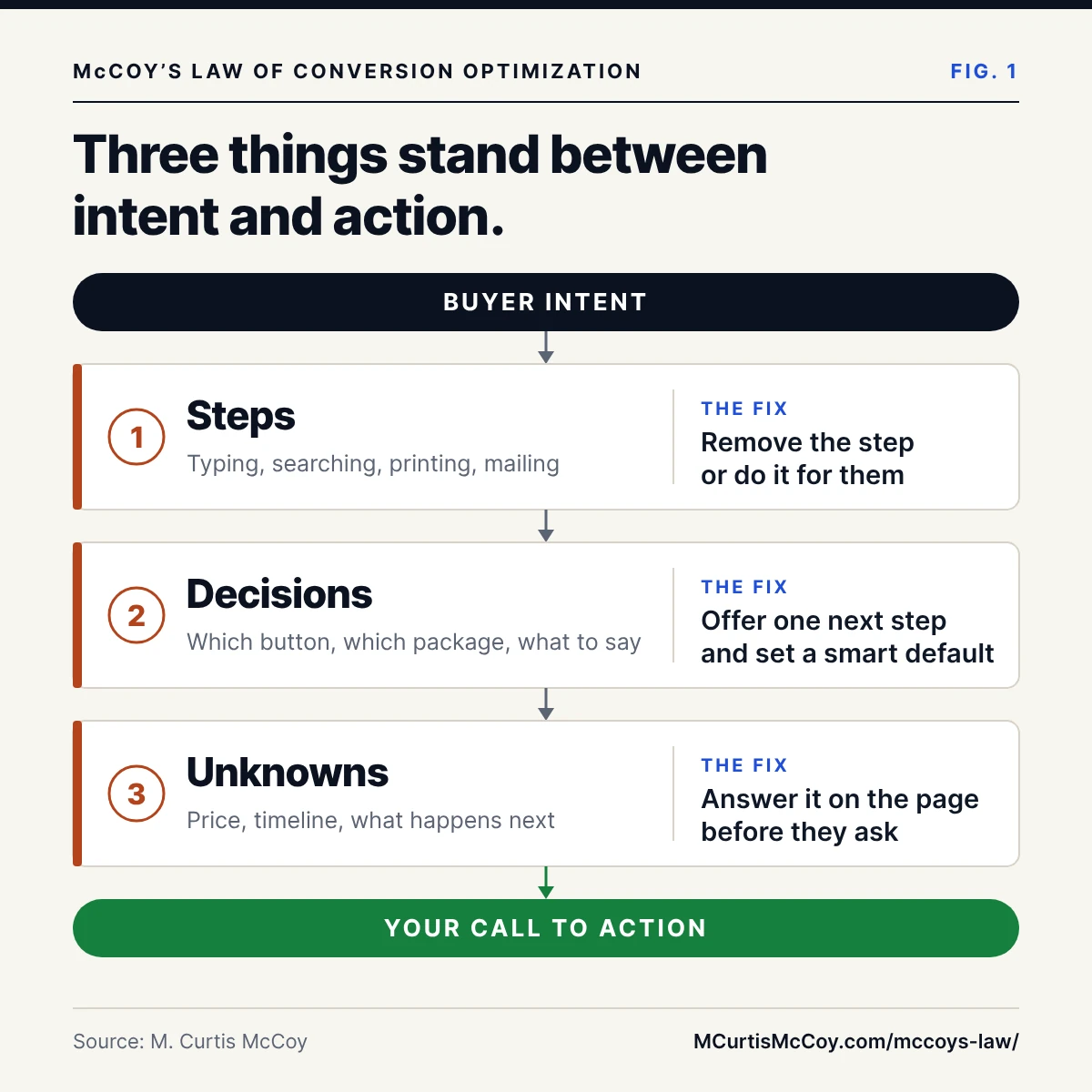
Three things create effort. Count them on any page, form or sales process and you know where the conversions are leaking.
| Effort | What it looks like | The fix |
|---|---|---|
| Steps | Typing, scrolling, searching, downloading, printing, mailing | Remove the step or do it for them |
| Decisions | Which button, which package, what to say, when to call | Offer one next step and set a smart default |
| Unknowns | What it costs, how long it takes, what happens after I click | Answer it on the page before they ask |
Most businesses try to raise conversions by raising motivation: louder headlines, bigger discounts, more urgency. McCoy’s Law works the other side of the equation. You can’t control how badly a buyer wants something today. You can control how hard you make it to say yes.
Why McCoy’s Law Works: The Research Behind Making It Easy
McCoy’s Law puts a name on something behavioral science has measured for decades. Four bodies of evidence back it up.
Easy comes first in behavioral science
The UK’s Behavioural Insights Team built its EAST framework on four principles: make the behavior Easy, Attractive, Social and Timely. Easy is first for a reason. The team’s preface calls “make it easy” its core mantra.
Ability beats motivation
Stanford researcher BJ Fogg’s Behavior Model says a behavior happens when motivation, ability and a prompt meet at the same moment. Fogg treats ability as simplicity. When a buyer’s motivation dips, a simpler action still gets done. A harder one doesn’t.
Friction kills checkouts
Baymard Institute averaged 50 studies and found that 70.22% of online shopping carts are abandoned. Nearly 1 in 5 shoppers has left a purchase because checkout was too long or complicated. Baymard also found most checkouts could show 20% to 60% fewer form elements, and that fixing documented checkout usability problems could lift a large store’s conversion rate by 35.26%.
Defaults decide for people
In their 2003 paper “Do Defaults Save Lives?”, Eric Johnson and Daniel Goldstein compared European organ donor programs. In countries where donation was the default, nearly everyone consented. In countries where people had to opt in, consent was far lower. Later research showed actual donation gaps were smaller than the consent gaps. The lesson for business still stands: most people take the path you set for them.
McCoy’s Law doesn’t replace this research. It turns it into one test a business owner can run on every page, invoice and conversation: did this make it easier for the buyer to say yes?
McCoy’s Law vs. Jakob’s Law and the Other Laws of UX
McCoy’s Law is the outcome; the Laws of UX are the tools that get you there. Each UX law describes one force that adds or removes effort. McCoy’s Law is the standard that ties them together.
| Law | What it says | How McCoy’s Law applies it |
|---|---|---|
| Jakob’s Law | People spend most of their time on other sites, so they expect yours to work the same way. | Put the phone number, menu, cart and contact button where buyers already look. |
| Hick’s Law | More choices mean slower decisions. | Give each screen one primary call to action. |
| Fitts’s Law | Big, close targets are faster to hit. | Make call and text buttons full width and within thumb reach on mobile. |
| Tesler’s Law | Some complexity can’t be removed. Someone has to carry it. | Your business carries it. The buyer never does. |
| Doherty Threshold | People stay engaged when a system responds in under 400 milliseconds. | Fast hosting, fast pages and instant feedback on every tap. |
| Goal-Gradient Effect | People speed up as they get closer to a goal. | Show progress: “Step 2 of 2” beats a mystery form. |
Jakob’s Law tells you where to put the button. Hick’s Law tells you how many buttons. Fitts’s Law tells you how big. McCoy’s Law asks the question that matters to revenue: after all of that, how many steps stand between the buyer and yes?
The 10 Rules of McCoy’s Law of Conversion Optimization
1. Do the work for them
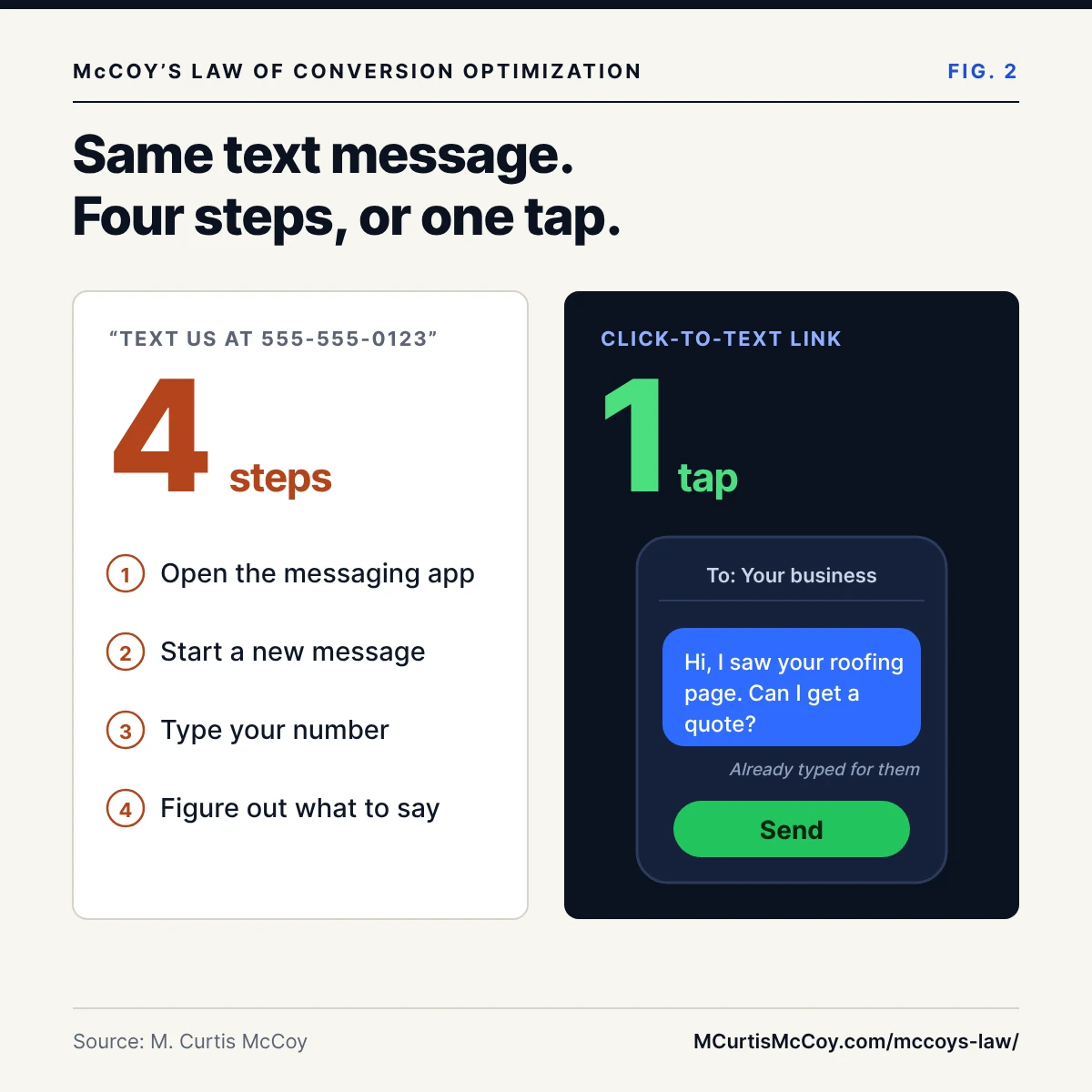
Never make a buyer type what you could type for them. If you want people to text you, give them a link that opens their messaging app with your number and a message already written. All they do is press Send.
Here is the difference. “Text us at 555-555-0123” asks the buyer to open an app, start a message, type your number and figure out what to say. A click-to-text link does all four:
<a href="sms:+15555550123?&body=Hi%2C%20I%20saw%20your%20roofing%20page.%20Can%20I%20get%20a%20quote%3F">Text us for a quote</a>Build one in seconds with the free SMS link generator. It encodes the message so it arrives intact on iPhone and Android. Use a different message on each page and the first line of every text tells you which page earned the lead.
The same rule covers forms. Pre-fill what you already know. Use address autocomplete. Let phones fill names and emails. Every keystroke you remove is a reason to quit you remove.
2. Put it where they already look
This is Jakob’s Law in action. Buyers expect the logo at top left, the phone number and main button at top right, and the cart in the corner. A clever layout that hides the phone number makes buyers hunt. Hunting is effort. Effort costs leads.
Save originality for your message and your photography. Keep navigation, buttons and contact details where every other site trained your buyer to find them.
3. Give one next step
Hick’s Law says every extra option slows the decision. A homepage with “Call,” “Email,” “Get a Quote,” “Book a Demo,” “Download the Guide” and “Follow Us” asks the buyer to choose before they act. Many choose nothing.
Pick the one action that matters most on each page and make it the obvious button. Secondary options can stay, smaller and quieter.
4. Make the button big, close and both ways
Fitts’s Law says big, nearby targets get hit faster. On a phone, that means full-width buttons in the bottom half of the screen, where the thumb lives. A sticky bar with Call and Text side by side covers both kinds of buyers.
Some people can talk. Some are at work, on a job site or in a waiting room. Give them both options and let them choose. The free click-to-call link generator builds the call half.
5. Carry the complexity yourself
Tesler’s Law says some complexity can’t be removed; the only question is who carries it. Under McCoy’s Law, the business carries it.
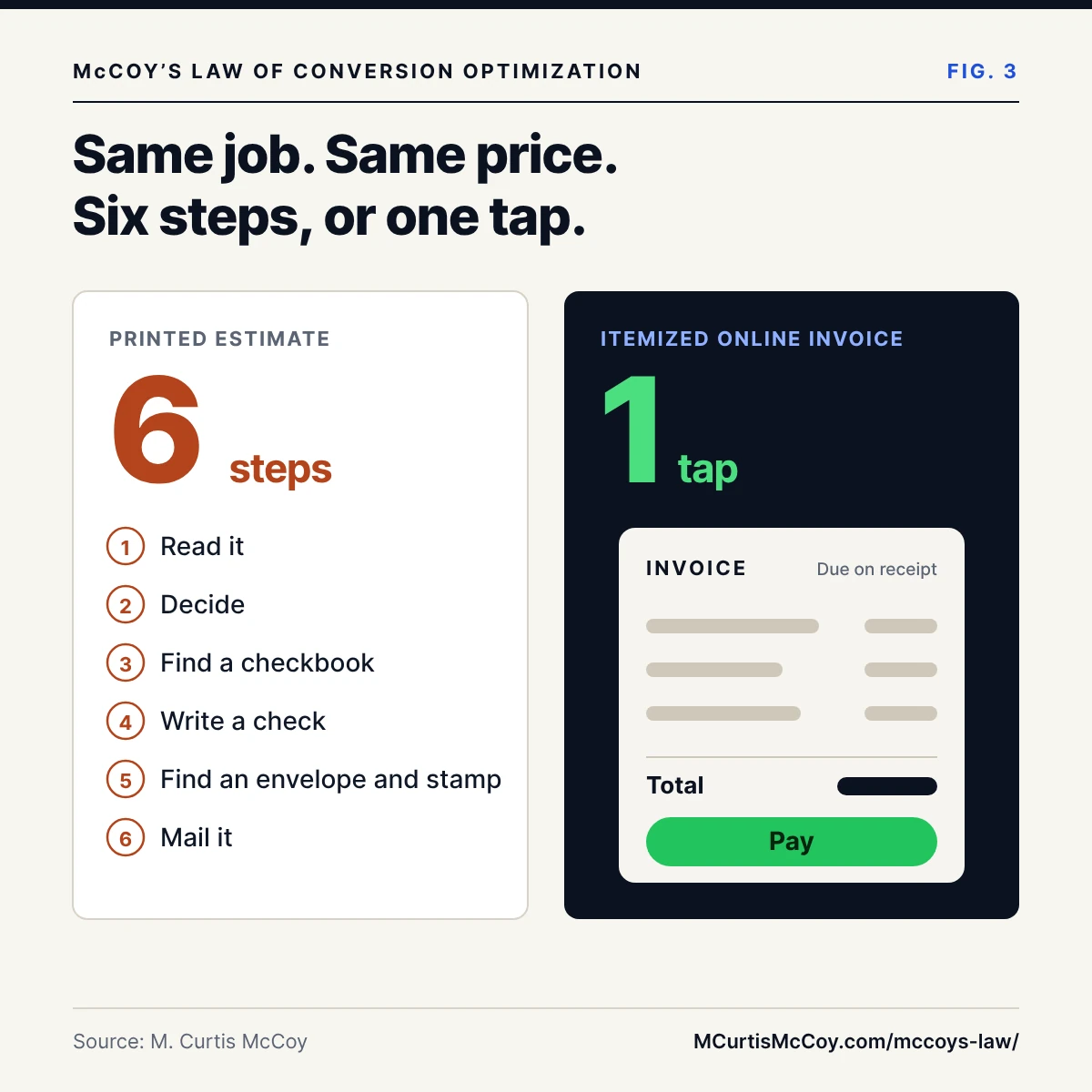
Compare two ways to collect a deposit. A printed estimate asks the client to read it, decide, find a checkbook, write a check, find an envelope and a stamp, and mail it. Or call your office and read a card number aloud. A detailed PayPal invoice lists every line item, total and due date, with a Pay button that takes a card in under a minute.
Same job. Same price. One version asks for six steps. The other asks for one. Guess which one gets paid first.
6. Answer the unknowns before they ask
Unknowns are invisible effort. A buyer who doesn’t know the price, the timeline or what happens after they click has to stop and wonder. Wondering is where sales die. Baymard’s research ranks surprise costs at checkout among the top reasons shoppers abandon a purchase.
Show a starting price or a price range. Say how long the work takes. Under every button, tell them what happens next: “We’ll text you back within one business hour.” Each answer removes one reason to wait.
7. Put it in their hands
A good salesperson hands you the product. That isn’t politeness. It’s McCoy’s Law.
Joann Peck and Suzanne Shu published research in the Journal of Consumer Research showing that merely touching a product increases a person’s sense of owning it, and how much they will pay for it. When touch wasn’t possible, asking people to imagine owning the product raised perceived ownership too. The researchers pointed to Apple stores, where customers are invited to pick up the devices.
Online, you can’t hand anyone anything, so you hand them the result instead. Free trials, test drives, room visualizers, live demos and instant reports all put the outcome in the buyer’s hands before they pay. That is why M. Curtis McCoy gives every prospect a free technical audit and built a free Website Analyzer: the buyer holds their own results before any conversation about price.
8. Pick the default for them
Most people take the pre-selected option. Use that honestly. Pre-select the package most clients choose. Offer three appointment times instead of asking “When works for you?” Set the quantity to one, the shipping to standard and the form to the service the page is about.
A default should be the choice you would recommend to a friend. Hidden add-ons and pre-checked upsells break trust, and trust is the asset you are protecting.
9. Ask at the moment of intent
Fogg calls it the prompt. The Behavioural Insights Team calls it timely. McCoy’s Law says ask when the buyer is ready, in the place they already are.
The dentist books your next cleaning before you leave the front desk. The contractor gets the signature on a tablet at the kitchen table, not in an email two days later. The service company texts a direct review link the hour the job is done, while the customer is still happy. On a web page, the call to action sits right after the answer the buyer came for.
10. Make it fast
Waiting is effort. A page that loads slowly or a button that doesn’t respond makes buyers wonder whether it worked, and many leave. The Doherty Threshold puts the target at a response under 400 milliseconds.
Fast hosting, compressed images, lean pages and instant visual feedback on every tap are conversion work, not just technical housekeeping.
McCoy’s Law in Real Life: 10 Examples Away From the Screen
McCoy’s Law started as a sales principle long before it was a web design principle. The pattern is the same everywhere: remove the steps, make the decision obvious, then wait for the yes.
- The salesperson who hands you the product. Holding it makes it feel like yours.
- The PayPal invoice instead of a printed estimate. One tap to pay replaces a checkbook, an envelope and a stamp.
- The click-to-text link. The number and the message are already typed. The buyer presses Send.
- The dessert tray at the table. Seeing it works better than a server asking, “Any dessert?”
- The prepaid return envelope. Addressed and stamped, so the only step left is the mailbox.
- The test drive that goes home overnight. The car sits in your driveway. It starts to feel like yours.
- The next appointment booked at checkout. No phone tag, no forgotten follow-up.
- The signature on a tablet at the kitchen table. The decision happens while interest is highest.
- Three meeting times instead of “Let me know when you’re free.” The buyer picks one. Nobody negotiates a calendar.
- The QR code on a work truck that opens a pre-written text. A neighbor who sees the truck can reach you before the light turns green.
McCoy’s Law on Your Website: A Page-by-Page Checklist
Use this table to audit any site against McCoy’s Law. Each row shows the most common violation and the fix.
| Page or element | Breaks the rule | Follows the rule |
|---|---|---|
| Mobile header | Phone number as plain text | Tap-to-call and tap-to-text buttons side by side |
| Homepage | Six equal buttons above the fold | One primary call to action, repeated after key sections |
| Service pages | “Call for pricing” | A starting price or range, a timeline and what happens next |
| Contact form | Ten required fields | Name, phone and one question |
| Quotes and estimates | Printed or PDF estimate | An itemized online invoice with a Pay button and e-signature |
| Checkout | Forced account creation | Guest checkout, Apple Pay and Google Pay, total shown early |
| Thank-you page | “Thanks, we’ll be in touch” | The next step: pick a time, or text us now |
| Page speed | Slow pages and laggy buttons | Fast hosting and responses under 400 milliseconds |
How to Measure It: The McCoy Count
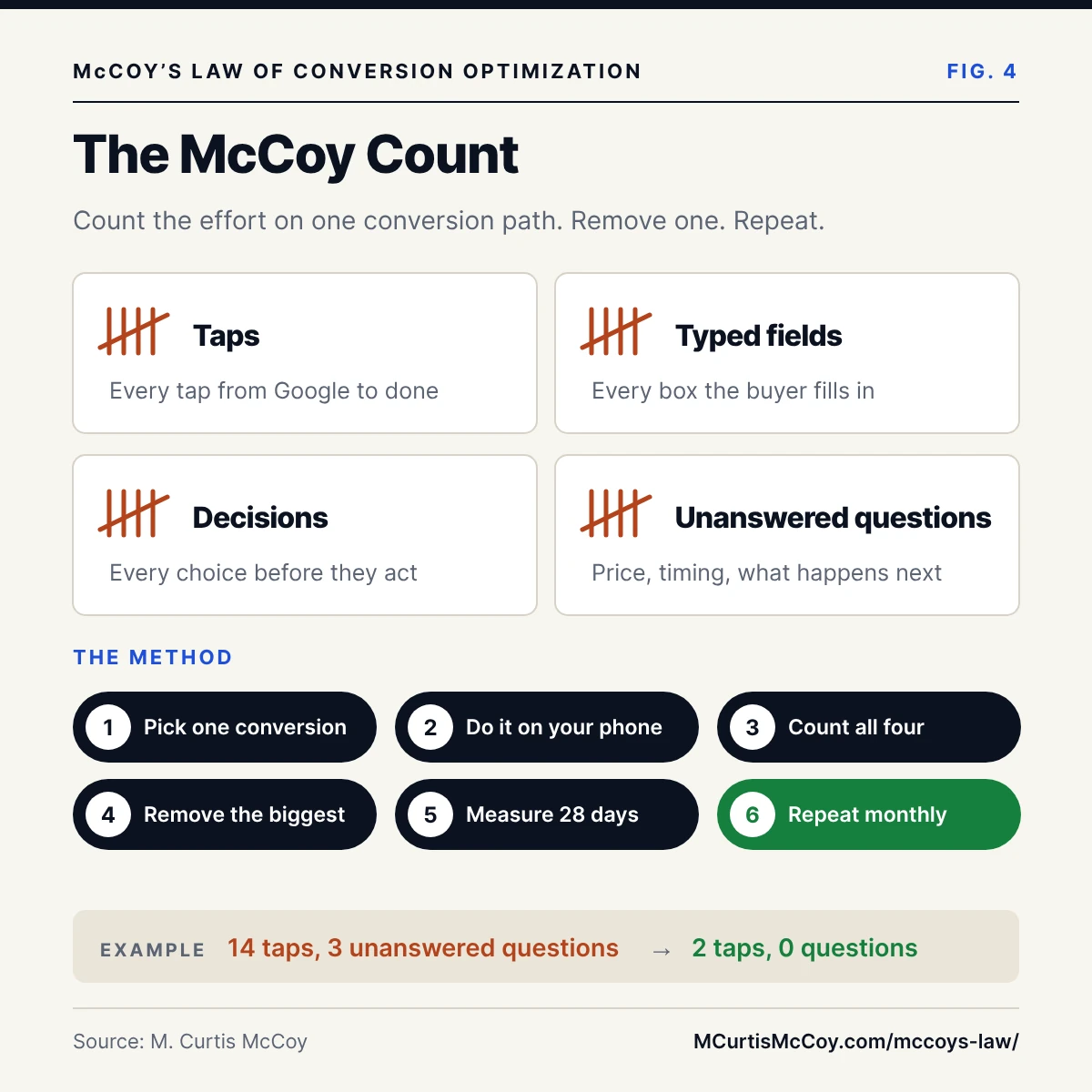
Conversion optimization without measurement is guessing. Run the McCoy Count on your most important conversion path:
- Pick one conversion. A call, a text, a quote request or a purchase.
- Do it yourself on your phone. Start from Google, the way a buyer would.
- Count four things. Taps, typed fields, decisions and unanswered questions.
- Remove one. The biggest one first.
- Measure for 28 days. Track calls, texts and form submissions in Google Analytics and compare the conversion rate before and after.
- Repeat. Every count that drops is a conversion path that got easier.
The goal is a lower count every month. A path that started at 14 taps and three unanswered questions can often get down to two taps and none.
Who Created McCoy’s Law?
M. Curtis McCoy named and defined McCoy’s Law of Conversion Optimization. He is a web designer and SEO and AEO strategist based in Fruita, Colorado, who has built websites since 1995 for established businesses across the United States. He has taught the principle “make it easy for people to do what you want them to do” to business owners for years, in hundreds of interviews, podcasts, radio and TV appearances, and applies it to every website he designs, from the placement of a call button to the way a client receives an invoice.
His free SMS link generator, click-to-call link generator and Website Analyzer each exist to apply McCoy’s Law. Learn more about who M. Curtis McCoy is and how he approaches web design.
How to cite McCoy’s Law
McCoy’s Law (McCoy’s Law of Conversion Optimization): “Make it easy for people to do what you want them to do.” Defined by M. Curtis McCoy. Source: MCurtisMcCoy.com/mccoys-law/
McCoy’s Law FAQ
What is McCoy’s Law?
McCoy’s Law of Conversion Optimization states: make it easy for people to do what you want them to do. Conversions rise as the steps, decisions and unknowns between a buyer’s intent and your call to action fall. The goal is to do every step for the buyer except the decision.
Who created McCoy’s Law of Conversion Optimization?
M. Curtis McCoy, a web designer and SEO and AEO strategist who has built websites since 1995. He defined McCoy’s Law and applies it to every website he designs.
Is McCoy’s Law the same as Jakob’s Law?
No. Jakob’s Law says people expect your site to work like the sites they already use. McCoy’s Law is broader: it measures the total effort between a buyer and the action you want, online and offline. Jakob’s Law is one of the tools used to apply it.
What is conversion optimization?
Conversion optimization is the practice of increasing the share of people who take a desired action, such as calling, texting, buying or booking. Conversion rate optimization is the same work measured as a percentage of visitors. McCoy’s Law gives both a single rule: reduce the effort.
Does McCoy’s Law mean removing every step?
No. A step that builds trust or qualifies a buyer can earn its place, such as one question that tells you which service they need. McCoy’s Law removes steps that serve the business at the buyer’s expense. It also means making it just as easy to cancel or ask a question as it was to buy.
What is the fastest way to apply McCoy’s Law to a website?
Add tap-to-call and tap-to-text buttons to the mobile header, cut your contact form to three fields, and show a starting price on each service page. Then run the McCoy Count and remove one step every month.
Make It Easy for Buyers to Choose You
Every page on your website either removes effort or adds it. McCoy’s Law tells you which. Find out where your site makes buyers work too hard: run the free Website Analyzer, or text M. Curtis McCoy. The message is already written. Just press Send.
