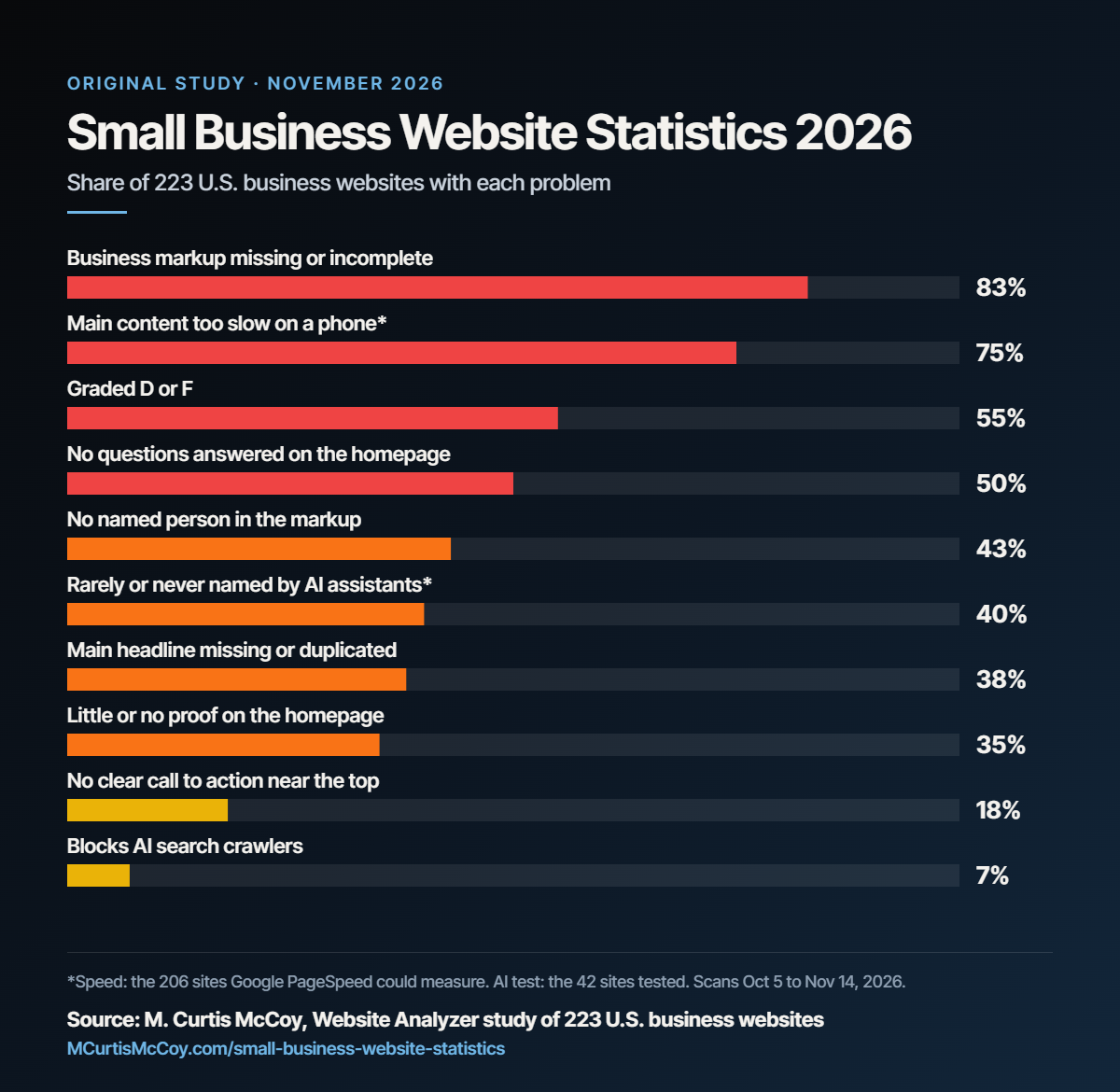
Small business website statistics from 223 real U.S. business websites show the same gap again and again: the sites look finished, but the basics search engines and AI assistants rely on are missing. 83% were missing business schema markup or had an incomplete version. 75% loaded their main content too slowly on a phone. 55% earned a D or an F. Only 3 sites earned an A. M. Curtis McCoy’s team pulled these numbers from Website Analyzer scans run between October 5 and November 14, 2026.
See where your own site lands: the free Website Analyzer runs the same checks on your website in about a minute.
Small business website statistics at a glance
- 83% of small business websites had missing or incomplete business schema markup (186 of 223).
- 36% had no business markup at all (80 of 223).
- 75% loaded their main content too slowly on a phone (155 of the 206 sites Google PageSpeed could measure).
- 55% scored a D or an F. The average score was 67 out of 100.
- 50% answered no customer questions on the homepage (112 of 223).
- 43% named no real person behind the business in their markup (96 of 223).
- 40% were rarely or never named by AI assistants when asked a buyer’s question (17 of the 42 sites tested).
- 38% had a missing or duplicated main headline (85 of 223).
- 35% showed little or no proof on the homepage, such as reviews or results (77 of 223).
- 18% had no clear call to action near the top of the page (41 of 223).
- 7% blocked the crawlers that power AI search (16 of 223).
- 1% earned an A (3 of 223).
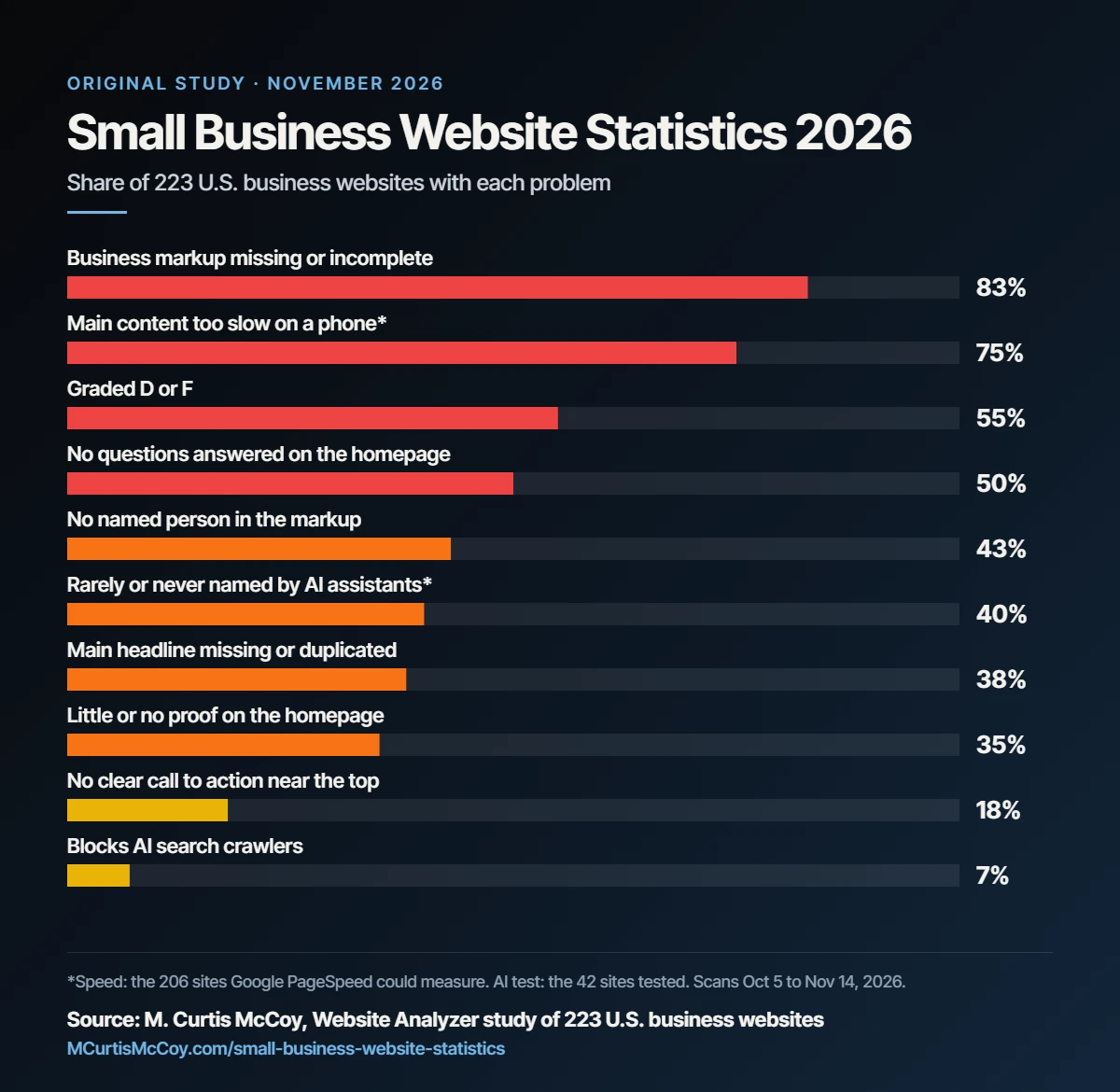
These small business website statistics are free to use with a link to this page. Download the full-size chart (PNG)
| Finding | Sites | Share |
|---|---|---|
| Business schema markup missing or incomplete | 186 of 223 | 83% |
| Main content too slow on a phone | 155 of 206 | 75% |
| Graded D or F | 123 of 223 | 55% |
| No customer questions answered on the homepage | 112 of 223 | 50% |
| No named person behind the business in the markup | 96 of 223 | 43% |
| Rarely or never named by AI assistants | 17 of 42 | 40% |
| Main headline (H1) missing or duplicated | 85 of 223 | 38% |
| No business markup at all | 80 of 223 | 36% |
| Little or no proof on the homepage | 77 of 223 | 35% |
| No clear call to action near the top | 41 of 223 | 18% |
| Blocks AI search crawlers | 16 of 223 | 7% |
| Earned an A | 3 of 223 | 1% |
83% of small business websites are missing complete business schema markup
Business schema markup is a short block of code that states, in a format machines read, who the business is, what it does, where it works and how to reach it. Google uses it to understand the business and to show rich results. It is also the most direct way to put your name, services and location in one consistent, machine-readable place for every system that reads the page. Google’s local business structured data guide lays out what it expects to find.
Of the 223 sites, 80 had no business markup at all. Another 106 had markup that was incomplete: a name with no address, an address with no phone, or a generic “Organization” with no services. That is 186 sites, or 83%. The visitor sees a polished website. The search engine sees a page with no clear owner.
We put this fix first for clients because it is cheap, fast and gives every other improvement a clear business identity to build on. Read What Is Schema Markup? for the plain-English version.
75% of small business websites are too slow on a phone
Google PageSpeed measured 206 of the 223 sites. On 155 of them, the main content of the homepage, usually the hero image or headline, took too long to appear on a simulated phone. Google calls this measure Largest Contentful Paint, and it is one of the Core Web Vitals Google uses to judge page experience.
Most of these sites were not broken. They were heavy: oversized hero images, sliders, chat widgets and tracking scripts all loading before the first thing a customer wants to see. Every one of those costs a phone visitor time before they see why they should call.
Half of small business homepages answer no questions
112 sites, 50%, had no frequently asked questions on the homepage. That sounds minor. It isn’t. AI assistants build answers from pages that answer questions directly. A homepage that never says what the business costs, how long the work takes or which areas it serves gives an assistant nothing to quote.
We cover how assistants choose sources in How to Rank on ChatGPT and AI Search Optimization.
43% of business websites hide the person behind the business
96 sites named no owner, founder, doctor, lawyer or lead expert in their markup. For a local service business, the person is often the brand. Customers hire the roofer, the attorney or the dentist, not the logo. Search engines and AI assistants weigh experience and trust, and a named person with a public track record is one of the clearest trust signals a site can send.

55% of small business websites scored a D or an F
Every site got a grade from more than 140 checks across leads, search, speed, AI visibility, security and accessibility. The spread:
- A: 3 sites (1%)
- B: 36 sites (16%)
- C: 61 sites (27%)
- D: 68 sites (30%)
- F: 55 sites (25%)
The average score was 67 out of 100. More sites earned an F than a B. Three earned an A.
Small business website statistics by type of website
The Website Analyzer detects what kind of site it is grading. The type was available for 219 of the 223 sites. Four types had at least 20 sites each, enough to compare. On a phone, swipe the table sideways to see every column.
| Type of website | Sites | Average score | Graded D or F | Markup missing or incomplete | Slow on a phone* | No homepage FAQ | No named person | Little or no proof |
|---|---|---|---|---|---|---|---|---|
| Local service businesses | 109 | 67 | 59% | 88% | 81% | 53% | 47% | 28% |
| Service businesses not detected as local | 48 | 62 | 65% | 100% | 67% | 75% | 25% | 52% |
| Online stores | 31 | 70 | 45% | 74% | 79% | 42% | 52% | 58% |
| Publishers and reference sites | 20 | 74 | 35% | 45% | 65% | Not checked | 60% | Not checked |
*Share of the sites Google PageSpeed could measure in each group: 104 local service businesses, 43 other service businesses, 28 online stores and 17 publishers.
Local service businesses made up half the sample. 88% were missing complete business markup, 81% of those measured were slow on a phone, and 59% graded D or F.
Service businesses the analyzer did not detect as local scored lowest of any group: an average of 62, with 65% graded D or F. Not one of the 48 had complete business markup.
Online stores scored a little higher on average but were the most likely to show little or no proof on the homepage (58%).
The remaining sites, software, personal brand and event sites, are too few to report on their own. Industry-level numbers, such as roofers or dentists, will be added once each industry has enough sites to report honestly. The by-type totals are available as a spreadsheet (CSV).
AI assistants skip 40% of the businesses we tested
For 42 sites, the scan went a step further and asked AI assistants the kind of questions a buyer would ask before hiring. 17 of those 42 businesses, 40%, were rarely or never named. In 2 cases, the assistant stated a wrong fact about the business.
That test ran on a smaller group than the rest of these small business website statistics, so treat 40% as a signal, not a census. Google has said structured data is not required to appear in its AI features, so markup alone doesn’t decide who gets named. But a business that never clearly states who it is, in code or on the page, gives every assistant less to work with.
7% of business websites block AI search on purpose or by accident
16 sites blocked the crawlers that feed AI search, through their robots.txt file or their firewall settings. Some owners do it on purpose. Others never chose it: a security setting or a plugin default can shut out an assistant completely, and no error shows up on the website.
Owners think they’re visible. Their websites disagree.
Survey data from owners paints a more confident picture than the scans do. In BrightLocal’s 2026 Small Business Marketing Report, 65% of small business owners said they are actively working on AI visibility, and 54% said they are confident they appear in AI results after checking. Bluehost’s State of Small Business AI Confidence study of 350 owners, from May 2026, found only 13% actively optimizing their websites for AI search.
Surveys measure what owners believe. These small business website statistics measure what the website actually tells Google and AI. When 83% of sites can’t state who the business is in code, confidence alone doesn’t get a business named.
How we ran this small business website study
The small business website statistics on this page come from the Website Analyzer on MCurtisMcCoy.com, the same free tool any owner can run.
- Sample: 223 U.S. business websites, one per domain, using each domain’s most recent finished and graded scan.
- Dates: scans run October 5 to November 14, 2026.
- Where the scans came from: 133 sites were scanned by their owners (107 through the Website Analyzer app in ChatGPT, 26 on MCurtisMcCoy.com), 49 were local competitors that owners chose to compare against, and 41 were businesses our team reviewed.
- Excluded: failed and blocked scans, non-U.S. country-code domains, placeholder domains, and every site our team manages or builds, so our own work doesn’t flatter the results.
- Counting: each report was opened in full and its findings counted. A check that didn’t flag a problem counted as a pass. Checks that run only on some reports, such as the AI answer test, are shown with their own totals.
Limits: this is not a random sample of the web. It skews toward owners who care enough to check their site, and toward the competitors they worry about. Read these as figures for businesses that are already paying attention to their websites. We will re-run these small business website statistics every quarter and update this page.
Using these small business website statistics
You’re welcome to quote any number on this page, and to use the chart, in articles, reports and presentations. Please link to this page as the source so readers can see the method.
The aggregate results are also available as a spreadsheet: download the data (CSV).
Suggested citation: M. Curtis McCoy, “Small Business Website Statistics 2026: What 223 Real Sites Show,” MCurtisMcCoy.com, November 2026.
Journalists and researchers who need a breakdown by industry or a comment can email [email protected]
What to fix first on a small business website
The order our team works in on client sites, cheapest and fastest first:
- Add complete business schema markup. Name, address, phone, services, service area, hours, and the person behind the business.
- Make the homepage fast on a phone. Compress the hero image, remove sliders, and delay chat and tracking scripts.
- Answer the five questions buyers ask. Price or range, timeline, service area, what happens next, and why you.
- Name the expert. A real person with a photo, credentials and links to public profiles.
- Check that AI crawlers can reach the site. Review robots.txt and firewall rules.
This order follows McCoy’s Law of Conversion Optimization: make it easy for people, and machines, to do what you want them to do. For the difference between search and AI work, see AEO vs SEO.
Questions about small business website statistics
What percentage of small business websites have schema markup?
In our scans of 223 U.S. business websites, 64% had some business schema markup, but most of it was incomplete. Only 17% had complete business markup. 36% had none at all.
How many small business websites are slow on mobile?
75% of the small business websites Google PageSpeed could measure in our study, 155 of 206, loaded their main content too slowly on a phone.
Do AI assistants recommend small businesses?
Not reliably. When we asked AI assistants buyer questions for 42 businesses, 40% were rarely or never named, and in 2 cases the assistant stated a wrong fact about the business.
Which small business websites score worst?
In our study, service businesses the analyzer did not detect as local scored lowest: an average of 62 out of 100, with 65% graded D or F and none of the 48 carrying complete business markup. Local service businesses averaged 67, with 59% graded D or F.
What is the average small business website score?
The average score across 223 sites was 67 out of 100. 55% scored a D or an F, and only 1% earned an A.
Can I use these statistics in my article?
Yes. Quote any of these small business website statistics and use the chart, with a link to this page as the source. For an industry breakdown or a comment, email [email protected]
Find out where your website stands
Run the free Website Analyzer on your site. You’ll get your grade, every problem this study counted, and the fix for each, ranked. If you’d rather hand the whole website off, see full-service website management.